
CCPN: Creating an NMR-MD pipeline
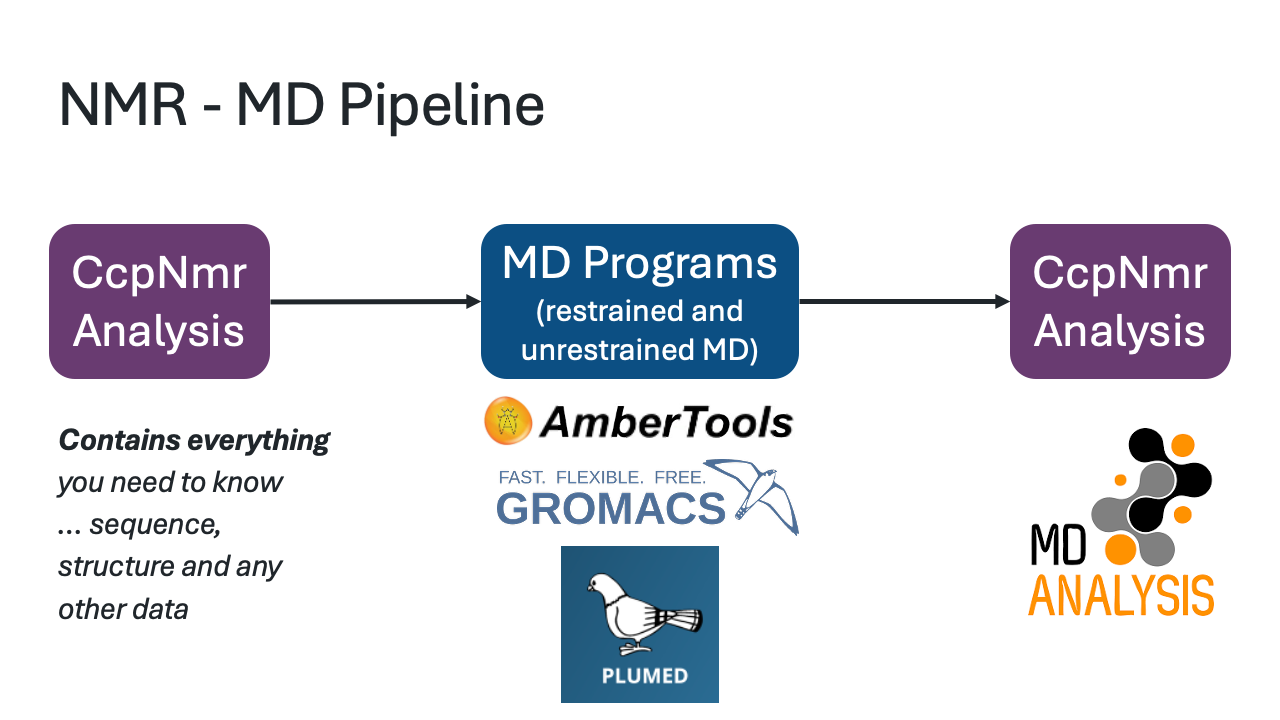
The goal is to create an easy pipeline for NMR spectroscopists to set up standard MD calculations with or without the inclusion of NMR restraints and then compare their trajectory to their NMR data. We are aiming for data transfer to occur via the NMR Exchange Format and shall initially target the Amber, GROMACS and Plumed software packages. Data analysis routines will be implemented within CCPN’s CcpNmr Analysis software using the MD Analysis library.
We are also working together with NMRbox to enable users to use this pipeline without having to install the MD programs themselves and being able to make use of the NMRbox compute resources.
CCP-EM: Heterogeneous reconstruction algorithms (HRA) in cryoEM
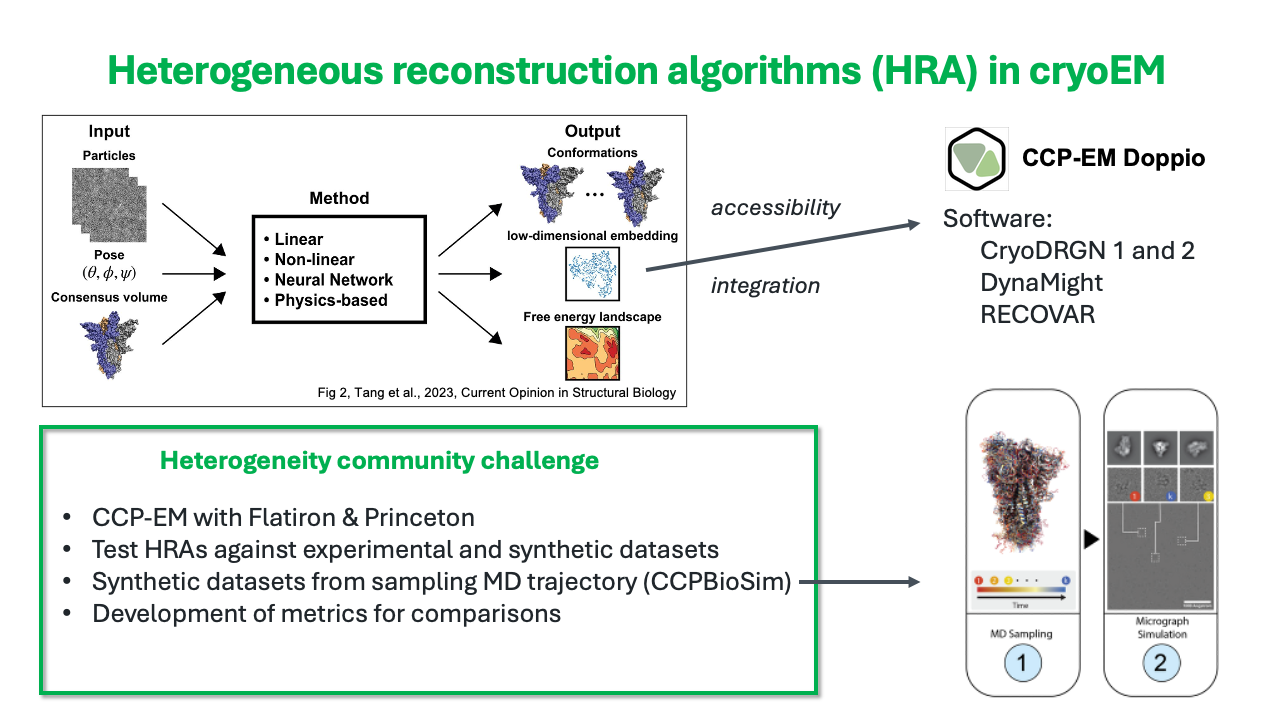
Our project involves integrating existing HRA software into the CCP-EM suite.
In addition we are organising an HRA community challenge together with researchers at the Flatiron Institute and Princeton University. A key infrastructural element is the development of metrics – how do we compare two latent space representations?
For the community challenge we are also using molecular dynamics simulations (MD) to generate ground truth data. We are doing this in collaboration with CCPBioSim using compute time secured through HECBioSim.
CCPBioSim: Using biomolecular simulation to enhance experimental resolution
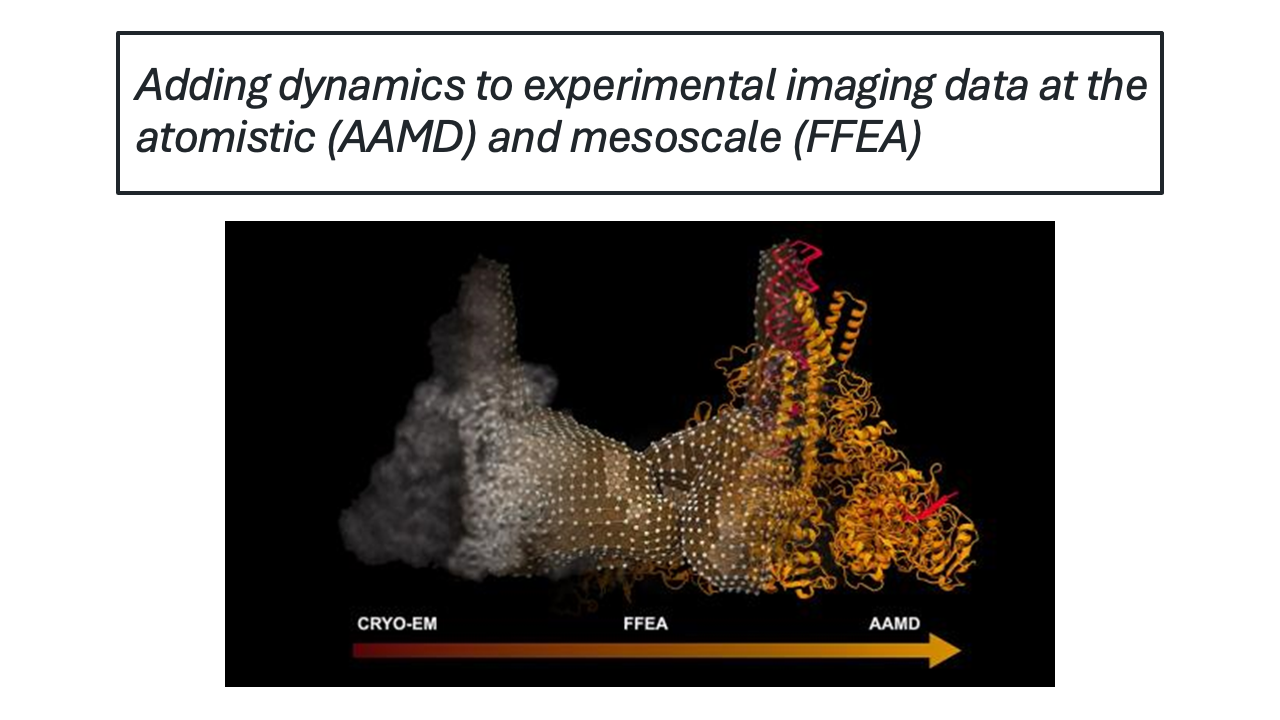
We are testing the ability of atomistic MD simulations to provide correct atomistic structures when fitting into low resolution cryo-EM density maps using synthetic datasets to validate the results and, if successful, assess how MD simulations might be integrated into CCP-EM toolkits.
Scattering techniques can provide detailed models when used synergistically with simulations to fit the experimental data. We are evaluating existing software tools (e.g. from CCP-SAS, ATSAS and CodeEntropy) to assess future requirements. We plan to run a community workshop to determine the future needs, challenges and opportunities for combining biomolecular simulations with X-ray and neutron scattering experiments for integrative biology.
In order to make use of omics data, we will also pilot the use of ChIP-seq data describing protein-DNA interactions to build structural models of protein decorated DNA sequences suitable for coarse-grained or atomistic MD simulations. We will design a confidence score for interactions and design prototype workflows for future automation of model creation.

CCP4: Heterogeneous computing and interfacing data models
The availability of large template databases for Molecular Replacement (MR) requires faster computational search tools and GPU acceleration. We are investigating how to reformulate MR algorithms for massive parallelisation on GPU devices, targeting a solution where translational and conformational searches are performed simultaneously
across all available GPU threads. Additionally, we are exploring the potential of AI/ML-based assessments of candidate MR solutions to outperform the conventional scoring methods based on root mean squared deviations (RMSD) template and target datasets.
We are also collaborating with CCP-EM to explore the benefits which the cryo-EM community can derive from similar GPU-enabled speed-ups.
Finally, we will provide a new description of biomolecular datasets as multi-conformational (relevant to crystallography) and multiple-state (relevant to cryo-EM data analysis), allowing identification of relationships between datasets from different methods and across laboratories with their specific expertise. Integrating data
formats across CCPs will facilitate cross-technique model analysis and can be used by advanced methods, e.g. in CCPBioSim. The proposed pilot scopes this for CCP-EM and CCP4 but is extensible to other techniques such as NMR (CCPN) and SAXS (CCP-SAS).